
Hush
Hush reduces some advertising by filtering DNS on the phone itself. No account, no subscription, no VPN server in the middle — a local VPN interface, an editable rule list, and counters that stay on the device.
Install the signed Android build directly — no store account needed, just side-load it. Android is available now; iOS is coming soon. The SHA-256 is published next to the file.
Side-load · Android now · iOS coming soon

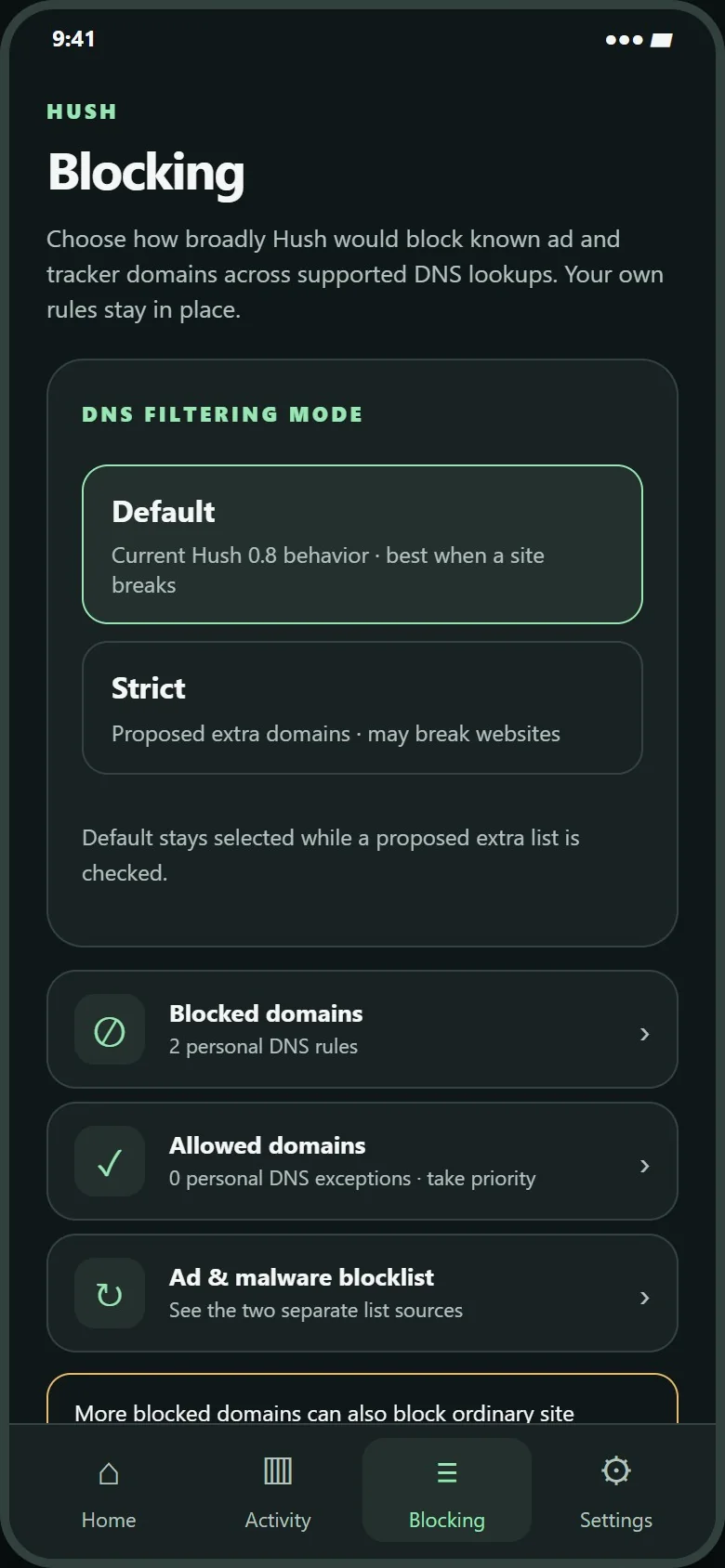

Screens rendered at 2× from Hush's own interface.
The problem
Most ad blocking on Android is either a browser extension — useless outside the browser — or a remote VPN that sees every request you make. Both trade privacy for the thing that is supposed to protect it.
The interesting constraint was to do it entirely on the device: no account, no subscription, no traffic routed through someone else's server.
What we built
- A local VPN that filters DNS. Turning protection on routes system DNS through a filter on the phone; nothing is tunnelled to a remote host.
- Editable rules. Add blocked domains, allow sites you trust, and the allow list takes priority. Each rule covers its subdomains.
- On-device counters. Blocked versus processed requests, visible at a glance.
- An optional hosts list. A public list can be downloaded and cached locally, when the user chooses to fetch it.
- An honest limits panel. The app states what it cannot do — apps using their own encrypted DNS, same-domain ads, a second simultaneous VPN — instead of implying universal ad removal.
- A two-mode blocking model. Default keeps today's behaviour; Strict adds the larger blocked set, designed with its own loading and unavailable states so a slow list refresh never looks like a failure. Strict is designed, approved-pending, and not shipped.
What the AI team actually did
The founding direction, the privacy stance and the "no account" decision were human calls. Everything downstream was produced by the AI team and verified:
- Android implementation, the filter service, and the hybrid web/native UI.
- Icon, wordmark and the store feature graphic.
- The verification records — consent flow, layout at multiple densities, and Android Auto behaviour each written up as a checked, dated report rather than a claim.
- Play listing and privacy policy, including the Data safety answers that the Cloudflare DNS and optional list download actually require.